
PAS 128 Utility Surveys
Enquire Today For A Free No Obligation Quote
At PAS 128 Utility Surveys, we specialise in the detection, mapping, and classification of underground utilities to a national specification developed by the British Standards Institution.
PAS 128 defines a structured approach to utility detection because misidentification or absence of underground records can cause health and safety risks, project delays, and expensive service strikes.
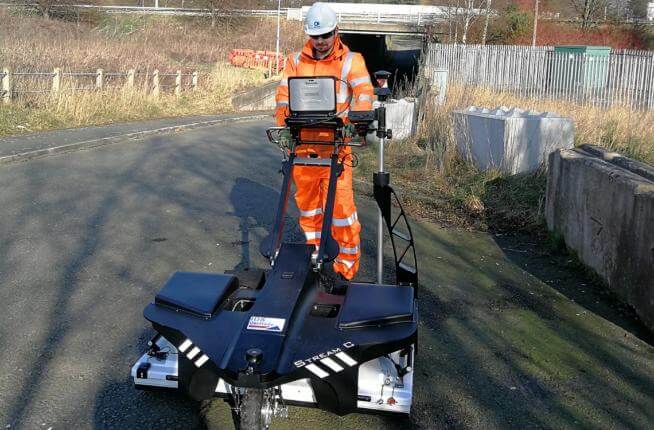
Using a combination of electromagnetic location (EML), ground-penetrating radar (GPR), and visual inspection, surveyors gather accurate subsurface data to a defined quality level.
Since modern infrastructure and construction projects rely on precise underground knowledge, the PAS 128 utility survey has become a standard requirement in pre-construction investigations.
Request a free quote from our expert utility survey technicians today.
What Is a PAS 128 Utility Survey?
A PAS 128 utility survey is a subsurface survey method that records the position, depth, and type of buried services using a consistent, graded methodology.
The specification outlines a set of four recognised survey types—ranging from desktop studies to on-site verification—and assigns a quality level (QL) to each service identified, indicating the accuracy and method of detection.
Since the PAS 128 methodology is traceable and auditable, it is accepted by contractors, local authorities, and utility providers across the UK.
Why Is a PAS 128 Utility Surve Important?
A PAS 128 utility survey is important because utility networks beneath urban and rural areas are often undocumented, inaccurately recorded, or congested.
Without proper investigation, excavation work carries a high risk of striking live services such as electricity, water, or gas.
By following the PAS 128 standard, survey data becomes more reliable and can be used for safe planning, accurate design, and efficient coordination with utility providers.
What Is Included in a PAS 128 Utility Survey?
A PAS 128 utility survey includes a detailed assessment of buried services using electromagnetic detection, GPR scanning, and manhole inspection.
All visible service features such as covers, chambers, valves, and marker posts are recorded. Geophysical equipment is then used to detect metallic and non-metallic utilities below ground.
Surveyors classify each service line with a survey type (Type D, C, B, or A) and assign a quality level (QL-D to QL-A) based on the certainty of the data.
Final deliverables include utility drawings in CAD and PDF format, with annotated service types, depth estimates, and a quality level key.
What Are the PAS 128 Survey Types?
PAS 128 defines four primary survey types. A Type D survey relies solely on existing record drawings, while a Type C survey adds site reconnaissance to identify above-ground evidence.
Type B is the most common detection method using geophysical tools, and Type A involves physical verification through trial holes or direct visual inspection.
A PAS 128 utility survey often includes a combination of Type B detection with targeted Type A verification where access and safety allow.
How Accurate Is a PAS 128 Survey?
The accuracy of a PAS 128 utility survey depends on the quality level applied to each service.
Quality Level D is based on undocumented records and is the least reliable. Level C uses surface indications to estimate location.
Level B is based on electromagnetic or radar detection and is considered high confidence for design. Level A confirms the actual position through excavation or visual access and provides the highest possible accuracy.
We typically aim to deliver surveys to Quality Level B or A wherever site conditions permit.
How Much Does a PAS 128 Utility Survey Cost?
The cost of PAS 128 assessments ranges from £750 to £3,000+.
For small or straightforward plots, prices start around £750.
For larger commercial or infrastructure projects, the cost may exceed £3,000 depending on verification requirements and working conditions.
The cost of a PAS 128 utility survey varies depending on the size of the site, the complexity of underground infrastructure, and the required survey types.
Each quote is based on site drawings, known utility records, and access information.
Since every site is unique, we provide tailored pricing to reflect the survey scope and level of assurance required.
Who Needs a PAS 128 Utility Survey?
A PAS 128 utility survey is used by developers, contractors, design teams, and public authorities who need to identify buried utilities before starting any excavation.
Local councils may require PAS 128-compliant data before approving works in highways or public spaces. Design engineers rely on utility plans to avoid clashes and interruptions.
The survey is especially critical in urban areas, brownfield sites, or anywhere excavation work could risk damaging live services.
What Are the Benefits of a PAS 128 Utility Survey?
A PAS 128 utility survey provides clarity, safety, and regulatory compliance for any ground investigation or construction project.
The key benefits include:
- Reduces the risk of damaging underground utilities
- Improves site safety for workers and contractors
- Complies with CDM Regulations and HSE guidance
- Provides high-confidence data for design and planning
- Supports accurate excavation, piling, and drainage layouts
- Enables coordination with statutory undertakers and utility providers
- Delivers transparent, auditable data using nationally recognised standards
Since every successful construction project begins with knowledge of what lies beneath, PAS 128 ensures the information is both accurate and trusted.
How Long Does a PAS 128 Survey Take?
A PAS 128 utility survey can take anywhere from one day to several days on site, depending on the area to be surveyed and the number of utilities present.
Processing and CAD drawing production typically follow within 3 to 7 working days.
We can offer accelerated delivery on request for urgent design or procurement schedules.
Do You Combine Utility Surveys With Other Services?
We frequently combine a PAS 128 utility survey with services such as topographic surveys, drainage CCTV surveys, and measured building surveys.
This approach improves efficiency, ensures spatial consistency between datasets, and reduces overall project costs.
All combined surveys are carried out under unified control points and delivered in coordinated CAD or BIM-compatible formats.
What Types of Utilities Can Be Detected?
A PAS 128 utility survey can detect the most common subsurface services, including electricity cables, water pipes, gas mains, telecom ducts, and drainage runs.
Since electromagnetic and radar techniques respond differently to each material, the detectability of a service depends on its size, composition, and depth.
Non-metallic or fibre optic ducts may be more difficult to trace without supplementary access, such as inspection chambers or trace wires.
Can the Survey Show Depths of Utilities?
A PAS 128 utility survey provides estimated depths for each service where detection allows.
As electromagnetic and radar signals can reflect from surfaces at known intervals, software analysis allows depth to be calculated based on signal travel time.
However, depth values are considered indicative unless confirmed through trial holes or visual inspection under Quality Level A classification.
Is GPR Always Required for PAS 128 Surveys?
Ground-penetrating radar (GPR) is a standard method used in PAS 128 Type B detection surveys, and its inclusion improves the ability to detect non-metallic services.
Since not all utilities can be traced with electromagnetic equipment alone, GPR offers an additional detection method that complements EML tracing.
However, on heavily reinforced or clay-rich ground, radar signal performance may be limited, and surveyors will assess the effectiveness based on site conditions.
How Are Survey Quality Levels Determined?
Quality levels in a PAS 128 utility survey are determined by the method of detection and the certainty of utility identification.
As each detected line is assigned a level from QL-D (lowest confidence) to QL-A (highest confidence), clients can see where services are accurately traced, estimated, or confirmed.
The grading system allows engineers and contractors to assess the level of risk before excavation or design work proceeds.
What Happens If the Site Has No Records?
If no utility records are available for a site, the survey will begin as a Type C reconnaissance and proceed to Type B detection using geophysical equipment.
Since Type D surveys rely entirely on third-party records, their absence means a desktop phase cannot be completed, and more emphasis is placed on site-based detection.
We always recommend requesting utility plans from relevant asset owners in parallel, but where this is not possible, detection can still be completed to PAS 128 standards.
Do You Mark Utilities on the Ground During the Survey?
During a PAS 128 utility survey, surveyors typically mark detected service lines on the ground using biodegradable spray paint or chalk.
As these markings assist in confirming linearity and help align CAD drawings with physical locations, they serve as temporary on-site references for clients or contractors.
Photographs of marked routes can be included in the final report to support visual verification.
Can You Survey Sites with Restricted Access or Operational Constraints?
We can carry out PAS 128 utility surveys on active construction sites, commercial premises, or areas with limited access windows.
Since many sites operate within strict access controls, we adapt our methodology to suit health and safety requirements, shift schedules, and permit systems.
Night or weekend work may be arranged in advance for critical infrastructure or high-traffic locations.
Do You Store Survey Data for Future Reuse?
All PAS 128 utility survey data is securely archived for future reference and reuse.
As many projects evolve through phased construction or require repeat visits for verification, we maintain a full digital record of all site data, control points, and detection history.
Digital records allows us to update utility maps efficiently, or provide evidence for audit trails and permit-to-dig systems.
Schedule a Professional PAS 128 Survey Today
A PAS 128 utility survey provides the certainty your project needs before any excavation begins.
As underground utilities represent both a risk and a responsibility, having a verified, classified, and georeferenced utility map is essential for safety, compliance, and cost control.
Whether you’re designing infrastructure, constructing buildings, or preparing for groundworks, PAS 128 ensures that your utility data meets the highest UK standard.
Get a free quote for a PAS 128 utility survey today, and take control of your underground information before breaking ground.
Find More Info
Make sure you contact us today for a number of great PAS 128 utility survey services.
For more information on PAS 128 Utility Surveys, fill in the contact form below to receive a free quote today.
★★★★★
We worked with PAS 128 Utility Surveys for a large mixed-use development in Birmingham, and their professionalism stood out from day one. Their team delivered highly detailed utility mapping that allowed our contractors to dig safely without any service strikes. The drawings were accurate, clear, and delivered on schedule. I’d definitely recommend them for any pre-construction survey work.
James Whitfield
Greater London
★★★★★
PAS 128 Utility Surveys provided an excellent service for our road improvement scheme in Manchester. The data quality and reporting exceeded expectations, giving us complete confidence before excavation began. Their engineers were thorough, communicative, and clearly experts in their field. We’ll be using them again on future projects.
Amelia Turner
Greater London